
Start from the graphic, not from the outfit
The familiar approach is to fix on a silhouette and hang everything else off it. I take the opposite route with That’s A Awful Lot Of Cough Syrup, because the graphic comes first. The brand’s meme hoodie own product copy keeps repeating one construction on tees and hoodies: jumbo screen prints at front and back. That is not some small chest hit that you can layer over and forget. The artwork is scaled to be read across a room, the wordmark usually being the artwork. You are not asking what goes with black cotton, but what goes with a sentence printed twice at full volume. Get that sequence right and everything after it solves itself.
Four honest points of departure
Weight decides how a piece hangs, so the published specs matter more than any lookbook. The loudest piece comes first, and everything else builds down from it. That one decision sets the volume, and it beats balancing two statements afterwards. The classic tees come in 6.5 oz organic cotton, relaxed fit, at roughly $150 at the brand’s own store as of September 2026, the classic hoodie sits at 16 oz organic cotton for roughly $200, and the sweatpants a 14 oz fleece for the same money. Treat those as a snapshot, as streetwear pricing shifts constantly. Garment facts here come from the brand and the opinions are clearly mine, across the four pieces people own first.
Start from the tee
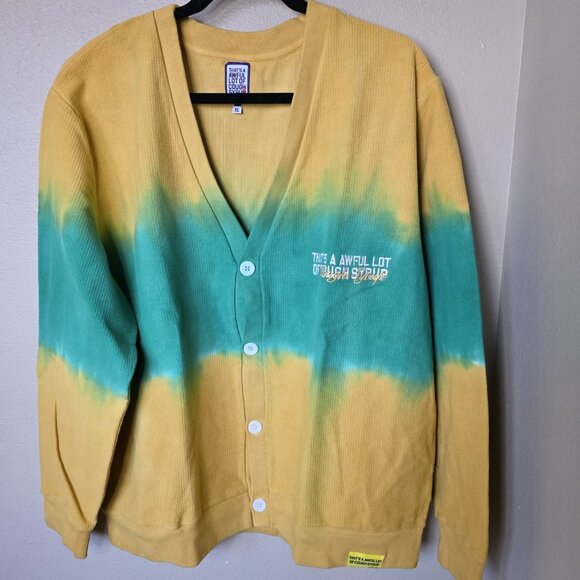
Nothing is an easier way in than cough syrup shirts, which are also the easiest to get slightly wrong. What you get in the classic tee is a relaxed cut in 6.5 oz organic cotton, jumbo screen prints front and back and a yellow woven label at the hem, published as fitting true to size. Loose-fit Dickies pants in the brand’s 65/35 cotton-polyester blend, or the denim cargo shorts when it is warm, give you the quiet, roomy half of the outfit. The printed sweatpants can wait for another day, which leaves the tee as the only thing talking. Because a relaxed tee over a narrow trouser reads as accident, a slim tapered leg is best avoided. I would not tuck it either, since the hem is where the label sits. A couple of the lightweight jersey tees are published as running small, with the brand suggesting one to two sizes bigger.
Start from the hoodie
Its weight is why the awful lot of cough syrup hoodie is a different animal. 16 oz organic cotton, hand-dyed and printed in Los Angeles: it keeps its own shape and will not drape over anything bulky underneath. The brand lists logos at the chest and across the back, the yellow woven label at the wearer’s bottom left, and says it fits true to size. Give it a flat, simple bottom half and let the back print work: carpenter pants, Dickies pants, or denim shorts in transitional weather. Because the back graphic is half of what you paid for, do not bury it under a puffer. Avoid stacking it over a printed tee, since two jumbo prints fight rather than layer. When the outfit is already busy, the black tonal version gives you the logo without the shouting.
Lead with the cargo shorts
A few different directions are open to Alocs shorts, but the denim pair has real construction to work with. A mid-rise 14 oz denim, garment-dyed by a double dye process the brand says mimics sun-fading, is what the Double Cup Cargo Shorts are, with double cup pockets at the back, cargo pockets at the side and a custom leather patch. Start with the published inseams: 7.75 inches on small through 9.5 on 2XL, with waists from 28 to 44. They run true to size, and the brand says to size up one for an oversized fit. Throw a plain heavyweight tee on top, or the Dickies button down worn open, and hold the colour simple, since the shorts come in grey, black and green, purple and red. Skip a second cargo-pocket piece, because side pockets stop reading as a detail once they are everywhere. Any top that hangs below the hem makes the shorts vanish entirely, so that is one to avoid.
Begin with the sweatpants
The classic sweatpants are made up as a 14 oz fleece published as 80 percent cotton and 20 percent recycled polyester. Printed across the front and up the back legs, the logo carries the detail people miss: the print runs vertically, so these are a graphic garment, not a neutral base. Flare cuts sit alongside the straight ones, and the fit is true to size. Put a plain tee or a tonal hoodie with them and let the leg print carry the look. Leave the jumbo-print tee off over them, because both prints sit at roughly the same height and cancel out. If you want a set, matching Athletic Dept. pieces exist, and I have no objection, as long as you accept that a set is a uniform.
The loud graphic, balanced
My working rule: one loud thing per outfit, and everything else earns its place by staying quiet. The yellow woven label does real work on an otherwise plain hem, and black and yellow are described as the brand’s signature colours. A second focal point only splits the one the outfit already has, once the graphic is the wordmark printed large. Tonal pieces are the pressure valve, so a black tonal hoodie lets you wear awful lot of cough syrup gear without the outfit being about the slogan. The other lever is colour, from grey and purple on the denim to ice blue elsewhere, so you can pitch the volume before the print is considered. Accessories pick up what attention is left, since a bandana near $25 adds brand presence for less than another printed garment. The name references promethazine-codeine cough syrup, known as lean, which is worth knowing, and the graphics draw on medical and horror imagery accordingly.
Getting proportion right, fit on fit
Proportion is where alocs clothing either looks considered or looks random. The published measurements tell you more than any campaign image: the lightweight jersey tees run 20 inches wide by 17.5 long on small, 21.5 by 19 on medium and 23 by 20.5 on large. The shape those numbers describe is wide and short, a different shape from the relaxed classic tee, and it wants a different bottom half. Full-length loose pants rather than shorts, given that a wide-and-short top wants length and volume. Heavy pieces behave the opposite way, since a 16 oz hoodie has structure already and needs no voluminous leg competing with it. Inseams of 7.75 to 9.5 inches leave the denim shorts short by current standards, pushing the balance upward and making a boxier top read correctly. Per product, the brand publishes fit guidance, with true to size as the default, some styles inviting you to size up, and a couple running small.
The short version, garment by garment
Everything above compresses into a table, the version I would text a friend. Left column, the piece you start from; middle column, what I would put with it; right column, what I would leave in the closet. Not one line of it is a rule. The brand’s published specifications supply the garment details; the opinions about what clashes are mine. Starting from one piece gives you one hard decision per outfit. Every drop shifts availability, which is why the catalogue is worth checking first.
| The starting piece | What it pairs with | What I would avoid |
|---|---|---|
| The relaxed 6.5 oz tee | Loose Dickies pants, carpenter pants, denim shorts | Tapered legs, printed sweatpants, a tucked hem |
| The 16 oz cotton hoodie | Carpenter pants, Dickies pants or denim shorts | A puffer over the back print, any second jumbo print |
| Double Cup Cargo Shorts in denim | Plain heavyweight tee, Dickies button down left open | Another cargo-pocket piece, a top below the hem |
| Fleece sweatpants, 14 oz | Plain tee, tonal hoodie, a matching Athletic Dept. top | A jumbo-print tee sitting over the leg print |
| Dickies button down, the 65/35 blend | Open over a printed tee, with shorts or loose pants | Buttoning it up over the graphic you wanted to show |
Before you buy the next piece
Two practical things outrank every opinion above. The first: fit instructions live on the product page, because there is no global chart and the guidance differs between styles. The yellow woven label is the second, named at the hem on tees and at the wearer’s bottom left on the hoodie, checkable alongside the published fabric weights and real price levels. The brand runs its own online store plus locations on Melrose Avenue and West 5th Street in Los Angeles and Almeda Road in Houston. In September 2026 prices sat near $150 for a tee and $200 for a hoodie, and those numbers keep moving. Work from one piece, keep the second-loudest thing quiet, and let fabric weight do the rest.